By Nco Dube | 14 October 2026
Parliament has managed to turn a necessary attempt at procurement reform into another constitutional embarrassment. And before the familiar arguments begin about judges standing in the way of transformation, we should be clear about who is responsible for this one. The Constitutional Court did not prevent the state from using its purchasing power to address economic exclusion.
Parliament failed to make its law properly.
A legislature that is forever reminding us of its democratic mandate somehow overlooked one of the most basic obligations that comes with that mandate: listening to the public.
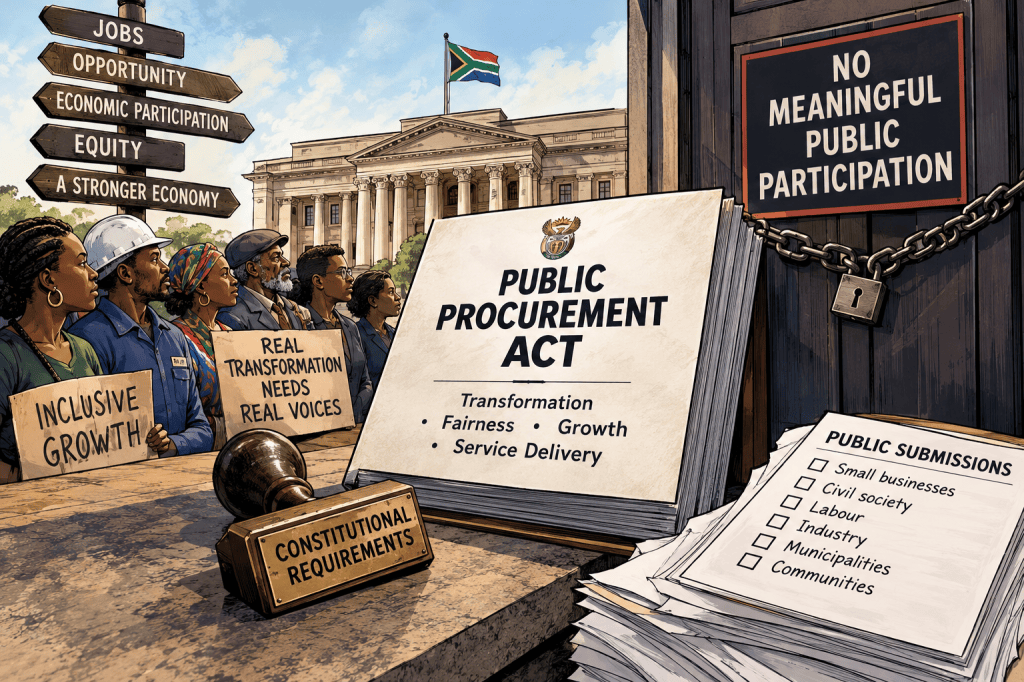
The Court’s September judgment invalidating the Public Procurement Act of 2024 was about the process through which it was passed. Significant changes were made to the preferential procurement provisions, including arrangements concerning set-asides, prequalification and subcontracting, without giving the public a meaningful opportunity to engage with what those changes would mean. Submissions were inadequately dealt with and consultation was compressed. This was not a technicality discovered by clever lawyers. These provisions would shape who qualifies for state business, who is excluded and how public institutions buy the goods and services on which communities depend.
Parliament was changing the rules of economic participation while failing to hear enough from those expected to live under them.
I find the failure particularly frustrating because the need for procurement reform is hardly controversial. The state spends enormous amounts of money acquiring everything from textbooks and medicines to roads, security services and municipal infrastructure. How it spends that money influences the structure of the economy as surely as many of the policies that attract far more political attention.
A procurement system can open opportunities to capable businesses that have been shut out for generations. It can also become a comfortable feeding trough for politically connected intermediaries, officials and established suppliers who have learned to exploit its weaknesses. We have enough experience of both possibilities to know that slogans will not tell us which one a new law is likely to produce.
South Africa cannot pretend that apartheid’s economic inheritance vanished when the vote was extended to everyone. Ownership, accumulated wealth, access to finance and established commercial networks continue to shape who gets to compete and on what terms. The black entrepreneur who must borrow at punishing rates is not entering the same market as a competitor whose business can draw on generations of accumulated assets and banking relationships. That is why I reject the argument that government should purchase as though the economy were already equal. But I also reject the suggestion that the righteousness of transformation puts its chosen instruments beyond scrutiny. If anything, the persistence of inequality should make us more demanding about whether those instruments work.
We have allowed a troubling confusion to take root between transferring an opportunity and creating productive capacity. A contract awarded to a black-owned business may be an important breakthrough. It may also be little more than a transaction in which someone with access to the right people inserts themselves between the state and the company that actually performs the work.
The paperwork may look transformed while the underlying structure of production remains almost untouched.
The politically connected intermediary earns a margin; the person with the equipment, expertise and workforce does the job; and the community is left to hope that what was contracted for eventually arrives. It is difficult to defend this as the full meaning of economic emancipation.
Consider instead a small construction firm employing artisans, buying equipment and slowly establishing a record of delivering decent work. Preferential procurement can help such a business cross a barrier that market incumbents barely notice. Yet a municipality that fails to pay its invoices promptly can destroy the same business it claims to be empowering. An elaborate tender system can favour the consultant who understands compliance theatre over the entrepreneur who understands the work. And a municipality with little engineering or financial capacity can make a spectacular mess of an otherwise defensible procurement policy. These are not arguments for abandoning preference. They are reasons to examine the full chain between awarding a contract and building a sustainable enterprise that can eventually compete beyond the state.
This is precisely the kind of discussion that proper public participation should improve. Small enterprises know where the entry barriers lie. Workers understand what happens when contracts are passed along a chain of subcontractors. Municipal officials can explain where an attractive provision becomes unmanageable in practice. Communities can tell Parliament about the school that was paid for but never finished, or the water project that survives in annual reports long after the taps have run dry.
Of course some submissions will be self-interested. Big business has never been shy about dressing its commercial preferences in the language of principle. Parliament is not required to obey every lobbyist or accept every objection. Its obligation is to listen seriously, make defensible choices and own the consequences.
Instead, consultation too often resembles a ceremony conducted after the important decisions have already been taken. Hearings are held, submissions are counted and reports are produced, but anyone who challenges the direction of travel is treated as an inconvenience. That habit crosses policy areas and political administrations. It reflects an attitude towards public power in which an electoral mandate is mistaken for an instruction to stop asking questions between elections. The Constitution was written precisely to prevent that understanding of democracy from becoming our normal way of governing. Its requirements do not disappear when a minister, an MP or a majority of the governing party is convinced that the objective is noble.
There is also something uncomfortable about the political company in which this judgment places those of us who support transformation. The cases were brought by the Western Cape government and the City of Cape Town, political opponents of the national government’s approach. Their motivations and policy preferences can be debated. Some defenders of the established economic order undoubtedly regard preferential procurement as an obstacle. But the identity of the litigants does not make Parliament’s procedural failure acceptable. A constitutional obligation either binds those in power or it does not. We cannot defend public participation only when the people complaining happen to share our politics.
The same applies in reverse. Anyone celebrating the judgment as proof that preferential procurement itself is unconstitutional is claiming a victory the Court did not award. Section 217 of the Constitution requires public procurement to be fair, equitable, transparent, competitive and cost-effective, while expressly allowing measures to advance those disadvantaged by unfair discrimination. The difficulty is not choosing one half of that sentence and ignoring the other. It is designing institutions capable of giving substance to both, in an economy marked by inherited exclusion and a state with too many serious weaknesses of its own.
What we should fear is the damage careless implementation does to the public legitimacy of transformation. Every inflated contract, unfinished clinic and tender awarded on the strength of political connections gives ammunition to those who would prefer government to retreat from redistribution altogether. The people who carry the greatest cost are rarely the politicians who wrote the policy or the businesses that collected the money. They are the parents whose children still attend overcrowded schools, patients waiting in deteriorating facilities and households whose streets and water systems remain neglected.
An empowerment certificate offers them little consolation when the service never materialises.
None of this requires us to accept the comforting fiction that the market, left alone, will produce justice. It requires us to be honest about the kind of transformation we are pursuing. If procurement is to shift economic power rather than simply distribute rents, it must help create firms with skills, assets, employees and markets beyond the next government tender. The state must pay its suppliers, punish dishonesty, develop the officials who administer contracts and stop confusing political loyalty with commercial competence. These are less glamorous tasks than announcing another sweeping law, but they are where much of the real work sits.
The Public Procurement Act had not yet come into operation when the Court struck it down. Parliament therefore has an opportunity to return to the legislation without pretending that South Africa must choose between constitutionalism and transformation. It should use the opportunity to listen properly and interrogate the design with the seriousness that such a consequential law deserves.
Our country has spent too many years mistaking the announcement of policy for its achievement. People excluded from the economy do not need another grand declaration delivered through a defective process. They need a state that knows how to change their circumstances and respects them enough to hear what they have to say


Leave a Reply