By Nco Dube | 20 August 2026
There is a peculiar constitutionalism that awakens near personal danger. It sleeps while questions gather dust. But when accountability approaches, suddenly every rule is sacred, every step potentially unlawful and every questioner prejudiced.
President Cyril Ramaphosa has become its most accomplished practitioner.
His objection to Adv Thandazani Madonsela SC as Chief Evidence Leader in the Phala Phala inquiry is not an isolated dispute. It is the latest movement in an unmistakable pattern.
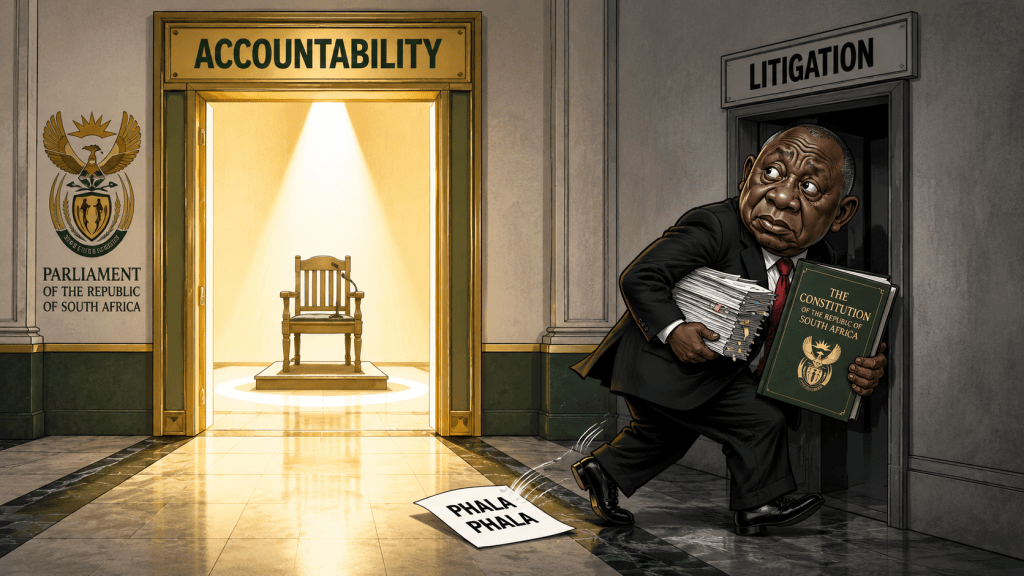
First, the Section 89 report was politically buried. When the Constitutional Court (Concourt) dug it out, the report had to be taken on review. When Parliament prepared to act on it, the public process had to be interdicted. Now the evidence leader must be challenged.
The architecture is visible. Accountability is divided into fragments, each made to crawl through the courts. The President need not win every battle. Sometimes delay is victory. Sometimes another door exists merely to avoid the room where questions wait.
The President has rights but so does the Republic
Ramaphosa is entitled to fairness, to challenge unlawfulness and to raise a genuine conflict.
There is a difference between defending one’s rights and exhausting every mechanism to prevent accountability reaching the merits; between due process and endless process. His defenders examine each manoeuvre separately. Democracy may examine the pattern.
The ConCourt invalidated Parliament’s 2022 rejection of the panel report and referred it to an impeachment committee. Ramaphosa responded by returning to court to attack that report.
He had stopped pursuing his original challenge after the African National Congress (ANC) caucus neutralised the report. While politically harmless, its alleged unlawfulness was tolerable. When the Court restored its consequences, its defects became urgent.
That chronology is crucial. A man desperate to clear his name does not leave a damaging report hanging over him because his party has neutralised it. A man desperate to avoid consequences might.
He then obtained an interdict stopping public proceedings. Again, a legal right produced delay. Phala Phala remains permanently imminent: always about to be examined, never reaching examination.
Now Ramaphosa objects to Madonsela. His letter even signals that litigation may follow if Parliament confirms the appointment. The message is restrained but unmistakable: remove the evidence leader or prepare to meet the President in court.
Madonsela turns on the light
Madonsela’s response to the President’s submission challenging his (Madonsela’s) suitability as Evidence Leader does more than deny bias. It exposes the imaginative labour required to manufacture it.
The President begins with a courteous Judicial Service Commission (JSC) departure, adds legal advice whose content he admits he does not know, borrows a former client’s concern that the former client itself disclaims, and ends by transforming an evidence leader who decides nothing into an adjudicator who supposedly threatens everything. This is not a demonstrated conflict. It is suspicion assembled backwards from a desired conclusion.
Madonsela says he disclosed both matters to Parliament’s Senior Parliamentary Legal Advisor on 27 July 2026. The Impeachment Committee did not wander blindly into an undisclosed conflict. It recommended him with his professional history before it.
The President is asking Parliament to reinterpret disclosed information through the darkest possible lens.
A grievance invented by the man who fears it
Ramaphosa’s first concern is that Madonsela may harbour a grievance because the President replaced him as a presidential designee to the JSC in 2022.
Madonsela’s letter of 28 March 2022 points in the opposite direction. He thanked Ramaphosa for advance notice, expressed gratitude for serving on the JSC, described it as an honour and wished him success.
Madonsela adds that he had no personal dealings with Ramaphosa while on the JSC, that replacement ordinarily ends such a designation and that nothing suggested stigma or personal reproach.
This does not make resentment impossible. But reasonable apprehension of bias cannot rest on hidden emotions. If Madonsela has displayed hostility or prejudgment, produce the evidence. Ramaphosa identifies none. Removal itself becomes proof of grievance.
That is dangerous. If everyone a President replaces must thereafter be treated as resentful, every removal creates another professional later declared unfit to scrutinise him.
Madonsela is a Senior Counsel, not a jilted courtier nursing a wound outside the palace gates. Bias cannot be manufactured out of biography.
The ANC’s concern that the ANC does not claim
The second objection concerns Madonsela’s previous legal advice to the ANC on matters relating to the Section 89 parliamentary process.
Potential conflicts and legal privilege matter. No lawyer should misuse a former client’s confidences.
Madonsela says he oversaw two draft opinions prepared by junior counsel. One concerned Parliament’s options in the interdict application; the other whether Assembly rules should require members to be fit and proper. He knew neither the merits nor underlying facts and left before argument.
The spectre of secret knowledge recedes when the lights come on. Madonsela says he did not advise on the money, burglary, Presidential Protection Unit or Ramaphosa’s version. His involvement concerned procedure, not the charges.
Parliament records that the ANC did not object to or question Madonsela’s integrity. Its representatives abstained. None voted against him.
The former client does not allege that its confidences are endangered. Yet Ramaphosa, admitting he does not know the advice, arrives as guardian of a privilege whose holder has not asked to be rescued.
The evidence leader is not the judge
The President dresses the evidence leader in judicial robes he does not wear.
Madonsela will not vote, make findings or decide removal. He assists the committee in presenting evidence. The committee evaluates it; the National Assembly exercises the section 89 power.
Ramaphosa may test the evidence and answer it. If the evidence leader acts unfairly, the committee can intervene. Fairness lies in the process, not in allowing its subject to disqualify difficult questioners.
Madonsela invokes Porritt, where the Supreme Court of Appeal (SCA) distinguished a prosecutor from an adjudicator and rejected the judicial recusal standard. An evidence leader is still less a decision-maker.
Prior knowledge is not prejudice. Parliament cannot appoint someone unfamiliar with Phala Phala, the judgment or section 89. Expertise includes knowledge. Treating knowledge as contamination makes Parliament prefer ignorance over competence.
The President contradicted by his own legal history
There is sharper irony. Madonsela cites Democratic Alliance v Public Protector, where Ramaphosa successfully resisted disqualifying bias. The Constitutional Court rejected conflicts that were imaginary, flimsy or far-fetched and warned against reactive bias.
Ramaphosa now advances a theory resembling the one he resisted. When another institution investigated him, professional friction was insufficient. When Madonsela may lead evidence, imagined private resentment becomes intolerable.
The legal principle has not changed. Only the identity of the person seeking its protection has.
The President of accountability who fears accountability
Ramaphosa came to office as the antidote to impunity, the man who would restore institutions and accountability. After the Zuma years, his calmness was presented as virtue and his constitutional vocabulary as moral seriousness.
Phala Phala has exposed the limits of that promise.
When scrutiny concerns his opponents, accountability is a national principle. When it concerns him, it becomes a technical dispute about jurisdiction, reports, appointments and timing.
He is entitled to be presumed innocent. But he appears unwilling to endure the process through which the unanswered questions may be tested publicly. He wants his name cleared without entering the room in which it must be cleared.
The country is not asking Ramaphosa to surrender his rights. It is asking why every right he invokes leads to the same destination: not yet, not here, not through this report, not before this committee, not with this evidence leader.
That repeated “not” has become his language whenever scrutiny turns inward. He affirms accountability in principle while contesting every route through which it might occur. He kneels at the altar of the Constitution, then litigates against its commandments. He sings hymns to institutions, then asks them to hold their breath.
The Constitution cannot become an instrument of attrition
If a powerful office-bearer can challenge the initiating report, interdict hearings, contest personnel and litigate every subsequent step, constitutional accountability may survive beautifully in theory while dying quietly in practice.
This is how institutions are hollowed out: not through outright defiance, but procedural suffocation. Rules remain. Committees exist. Courts sit. Letters are respectful. Yet nothing concludes.
Delay has a democratic cost. Memories fade, witnesses become unavailable, records grow harder to retrieve and public attention moves elsewhere. Political calendars overtake constitutional calendars. Time, strategically consumed, becomes an unofficial acquittal.
Parliament must examine the objections seriously. But it must not give the subject of an inquiry an effective veto over those assisting it.
The President is entitled to a fair process. He is not entitled to an endless one.
Madonsela has closed the latest escape route in argument. Ramaphosa may try reopening it through litigation. At some point, he must stop litigating around the truth and answer for it.
History will not remember how many objections he raised or how elegantly his lawyers framed them. It will remember that when accountability came looking for the President of renewal, he spent his energy searching for a side door through which to leave.
(Dube is a political economist, businessperson and social commentator on Ukhozi FM, SAFM and in various newspapers. For further reading and perspectives, visit http://www.ncodube.blog.)


Leave a Reply