By Nco Dube | 07 August 2026
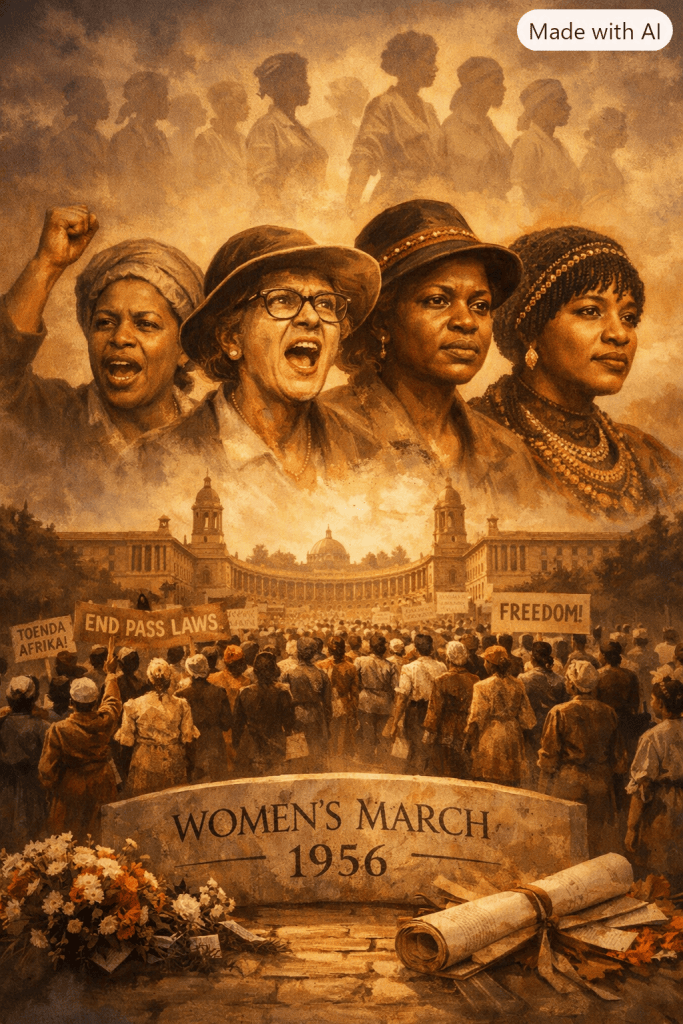
There are mornings when a nation wakes differently. When history does not stroll or whisper but gathers itself, rises and walks into the open. Does so with intention. The morning of 9 August 1956 was one of those mornings. Twenty thousand women crossed Pretoria’s winter light and approached the Union Buildings with a calm that felt like a warning. They did not come to plead. They came to declare. They came to insist that South Africa recognise what it had long refused to see: that women were not the footnotes of the struggle, but its spine.
To understand the power of that march, you must understand the world those women lived in. A world where Black women carried the weight of the country while being denied the right to stand upright. A world where they raised families in the cracks of an economy designed to break them. A world where they worked in homes that were not their own, stitched together communities the state tried to tear apart, and navigated the double violence of apartheid and patriarchy. A world where the pass system was not just a document but a chain. A world where the state believed it could decide their movement, their labour, their belonging, their future.
And yet, in that world, they organised. They built networks across race, class and geography. They strategised with a discipline that still feels astonishing. They refused to be divided by the apartheid state’s obsession with classification. They refused to be intimidated by police, by bureaucracy, by the threat of arrest. They refused to be silent.
The march was led by women whose names should be spoken with the same reverence we give to the giants of the liberation struggle. Lilian Ngoyi, whose voice could slice through fear and make crowds feel taller. Helen Joseph, who carried courage like a lantern through the darkest corridors of repression. Rahima Moosa, whose organising brilliance held the movement together with threads stronger than steel. Sophie de Bruyn, the youngest of the leaders, who walked into history with a quiet defiance that still echoes today.
They were not supporting characters. They were architects. They were strategists. They were thinkers. They were leaders. They were equals.
When they placed petitions at the prime minister’s door and stood in silence, it was not the silence of submission. It was the silence of judgement. It was the silence of women who had carried the country on their backs and were now demanding that the country recognise the weight of that labour. It was the silence of women who understood that dignity does not need noise to be heard.
That silence rolled across the lawns of the Union Buildings and settled into the country’s conscience. It lingered. It grew roots. It became a reference point for courage.
The march did not end apartheid. But it changed the trajectory of resistance. It showed that women could mobilise at scale. It showed that they could build coalitions across political organisations. It showed that they could confront the state directly. That they could lead.
And that leadership did not fade. It hardened. It evolved. It became sharper in the fires of the 1970s and 1980s, when the apartheid state grew more violent and more paranoid. Women stepped forward again, not because they were invited, but because the country needed them.
Victoria Mxenge stands as one of the clearest examples. A lawyer. A freedom fighter. A woman who used the law as a weapon against injustice and paid for it with her life. Her assassination in 1985 was meant to silence her. Instead, it amplified her. Her funeral became a rallying point for resistance. Her legacy became a reminder that women were not simply participating in the struggle. They were shaping it.
Winnie Madikizela‑Mandela carried another form of leadership. A leadership forged in the brutality of police raids, solitary confinement, banishment and surveillance. A leadership that refused to break even when the state tried to crush her spirit. She became a symbol of defiance, not because she sought the spotlight, but because she refused to surrender. Her leadership was complicated, contested and human. But it was leadership nonetheless. And it mattered.
There were others. Women who organised underground structures. Women who hid activists in their homes. Women who carried messages across borders. Women who built community organisations that kept families alive when the state tried to starve them. Women who led unions. Women who led student movements. Women who led civic protests. Women who led from the front and women who led from the shadows.
The march of 1956 planted a seed. The women of the 1980s watered it with courage.
And then democracy arrived. A new constitution. A new parliament. A new promise. But promises do not fulfil themselves. Women had to fight again. They had to insist on representation. They had to insist on gender equality. They had to insist on being seen not as beneficiaries of freedom, but as authors of it.
The first democratic parliament included women who had marched, women who had organised, women who had resisted. They brought with them a discipline shaped by struggle. They pushed for laws that protected women’s rights. They pushed for policies that recognised women’s labour. They pushed for institutions that could hold the state accountable. They pushed for a society that understood that liberation without gender equality is not liberation at all.
Today, seventy years after the march, South Africa stands in a different kind of quiet. A quiet shaped by frustration, inequality, violence and the unfinished work of democracy. But in that quiet, women continue to lead. They lead in parliament. They lead in civil society. They lead in business. They lead in communities. They lead in movements against gender‑based violence. They lead in the arts, in media, in academia, in activism.
They lead not because they are allowed to. They lead because they have always led.
The legacy of the march is not a statue. It is not a holiday. It is not a slogan. It is a lineage. A lineage of women who refused to be defined by the limits society placed on them. A lineage of women who understood that leadership is not a title. It is a practice. It is a discipline. It is a responsibility.
And as a man writing about this history, the responsibility is clear. To honour women without patronising them. To recognise their leadership without claiming ownership of it. To speak about their contributions without centring men. To understand that equality is not a performance. It is a principle. It is a way of seeing the world. It is a way of seeing women as full participants in the nation’s story, not as footnotes.
The women who marched in 1956 did not ask for permission. They did not wait for validation. They did not negotiate their dignity. They claimed it. They walked into the heart of the apartheid state and declared themselves citizens of a future that did not yet exist.
That future is still being built. And women are still building it.
The rest of us must catch up.
 The Social Commentator
Leave a comment