By Nco Dube | 25 July 2026
The Western Cape High Court’s judgment in Ramaphosa vs Speaker of the National Assembly and Others is a mirror held up to the President’s political soul. The majority’s decision to grant him temporary relief halting the impeachment hearings until his review of the Section 89 Panel report is heard reads less like judicial prudence and more like the legalisation of delay. It is the jurisprudence of hesitation, the triumph of process over principle.
The dissenting judgment by Francis J stands as the moral centre of the case. It refuses to confuse legality with virtue. It reminds us that the Constitution was not written to protect presidents from scrutiny but to protect citizens from presidents who fear it.
The Majority’s Shelter
The majority’s reasoning is wrapped in the language of caution. It speaks of balance, of separation of powers, of the need to avoid constitutional harm. Yet beneath that careful phrasing lies a dangerous indulgence, the idea that a sitting president may suspend accountability simply by invoking review proceedings.
By granting the interdict, the majority has allowed Ramaphosa to retreat once more behind the velvet curtain of legality. It has given him time, and time is the one resource he has always used to perfection. Time to reframe, to deflect, to wait for the storm to pass.
The judgment’s tone is procedural, but its effect is political. It transforms the courtroom into a sanctuary for executive evasion. It tells the public that accountability can wait, that transparency can be postponed, that the Constitution’s promise of ethical leadership can be deferred until the paperwork is complete.
The Dissent’s Clarity
Francis J’s dissenting judgement slices through the fog. He sees the President’s application for what it is, not a defence of constitutional rights but a strategy of delay. His reasoning is crisp. The report stands until it is set aside. The mere filing of a review does not suspend its operation. The President’s claim of irreparable harm is hollow because the harm he fears is not legal but reputational.
Francis J reminds us that the Constitution’s architecture was built to withstand discomfort. It does not promise leaders protection from embarrassment. It promises citizens protection from leaders who mistake embarrassment for injustice.
His dissent is not only a legal argument. It is a moral rebuke. It says that ethical leadership cannot hide behind interim relief. It must face the music even when the melody is discordant.
The President’s Pattern
The judgment fits neatly into Ramaphosa’s long choreography of avoidance. From the moment the Phala Phala scandal surfaced, he has treated accountability as a negotiation, not a duty. He has spoken of transparency while practising concealment. He has invoked the Constitution while using it as a shield.
The dissent exposes this pattern. It shows a president who moves only when cornered, who remembers his rights only when threatened, who treats the law as a refuge rather than a mirror.
The majority’s indulgence feeds that pattern. It allows him to continue the slow dance of deferral, the same rhythm that defined Zuma’s Nkandla years. The choreography is familiar: deny, delay, deflect, litigate, and then claim vindication when the clock runs out.
The Ethical Vacuum
Ramaphosa once promised a presidency of moral renewal. He spoke of rebuilding trust and restoring the dignity of public office. Yet every legal manoeuvre, every procedural pause, every appeal to due process has chipped away at that promise.
Ethical leadership does not wait for subpoenas. It does not hide behind technicalities. It does not seek refuge in interim orders. It steps forward unprompted and answers questions that have not yet been asked.
The dissenting judgment captures this truth in its refusal to indulge delay. It insists that accountability is not a threat to constitutional order but its lifeblood. The majority, by contrast, mistakes caution for wisdom and ends up protecting power from scrutiny.
The Coming Reckoning
The Phala Phala scandal is not going away. Like Nkandla, it will haunt the corridors of power until the truth is spoken plainly. The President may win time, but time is not absolution. The longer he hides behind process, the more the public sees through the performance.
Accountability is inevitable. It moves slowly, but it moves. The dissent understands this. It refuses to let the law become a stage for delay. It insists that the Constitution’s spirit demands courage, not convenience.
Ramaphosa’s downfall, if it comes, will not be because of the law. It will be because he mistook legality for legitimacy. He will fall not because the courts condemned him, but because the people saw that he had nothing left to say except “let the process unfold.”
Conclusion: The Law Cannot Save a Leader from Himself
The Western Cape judgment is a study in contrasts, between law as shield and law as mirror, between ethics as posture and ethics as practice. The majority judgement has given the President another reprieve. The dissenting judgement has given the country a reminder.
The reminder is simple. Ethical leadership is not measured by how well one manipulates the machinery of law, but by how willingly one submits to its light.
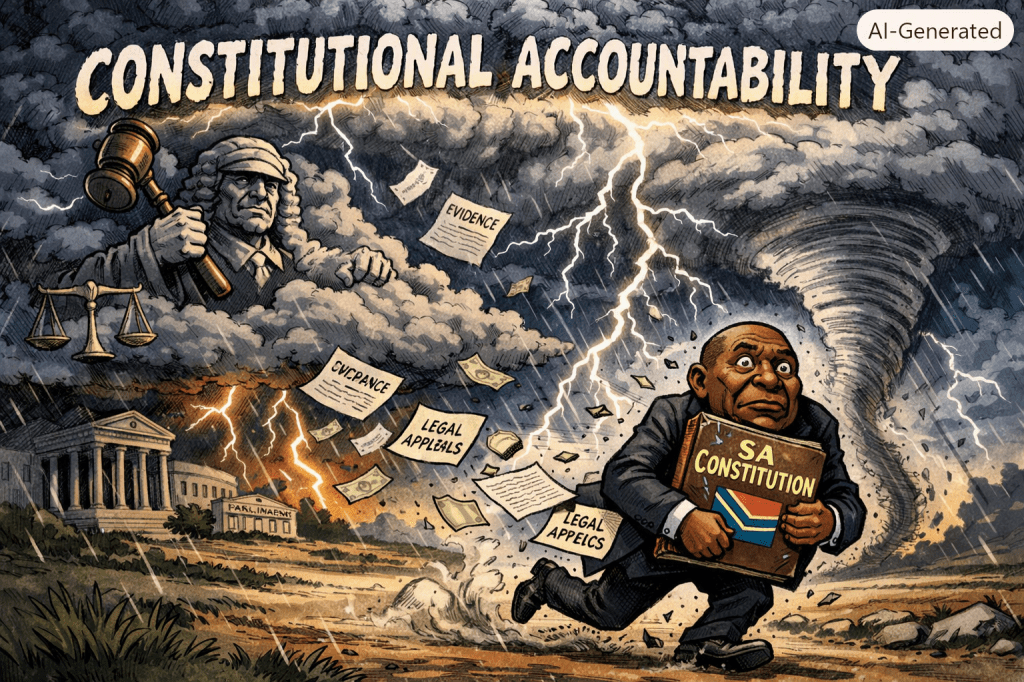
Ramaphosa may clutch the Constitution to his chest as the storm gathers, but the lightning of accountability is already in the sky.


Leave a comment