By Nco Dube | 26 June 2026
South Africa has built an entire political identity on the belief that we are a progressive society trapped inside a failing state. We repeat the Constitution like scripture. We quote Mandela like a mantra. We insist that our politics are rooted in liberation values and that our instincts are naturally aligned with human rights, dignity and equality. It is a comforting story. It allows us to imagine ourselves as enlightened citizens betrayed by corrupt leaders and collapsing institutions.
But the truth is far less flattering. Beneath the rainbow rhetoric and the constitutional poetry lies a country whose social instincts are deeply conservative. Not conservative in the polite, parliamentary sense. Conservative in the visceral, punitive, patriarchal, order‑obsessed sense. Conservative in ways that mirror the American Deep South more than the progressive democracies we claim to admire.
This conservatism is not confined to any one class or political formation. It runs through the entire spectrum of black South African society. It is present in the townships and the suburbs, in the churches and the WhatsApp groups, in the ANC and the EFF, in the IFP and the MKP, in the NGOs and activist circles that swear they are the vanguard of the left.
It is a conservatism that hides in plain sight, masked by the language of struggle and the performance of moral superiority. Yet it shapes our politics more than any manifesto ever could.
Borrowed Rhetoric and the Immigration Mirror
Nothing exposes this hidden conservatism more clearly than the immigration debate. When South Africans argue about undocumented migrants, they do not reach for African political history or regional economics. They reach for imported scripts.
On the right, we hear MAGA‑style rhetoric. Migrants are criminals. Migrants are invading our borders. The state must use force. These are not South African arguments. They are borrowed from American culture wars and repackaged for local consumption. They reveal a society far more comfortable with punitive instincts than with constitutional ideals.
On the left, we hear the inverse of the same rhetoric. Migrants are victims. Migrants are harmless. Migrants are all hardworking. We must be morally superior. This is the script of American liberalism, imported wholesale and deployed as a shield against confronting our own contradictions.
Both sides are outsourcing their thinking. Both sides are revealing their motives. Neither side is engaging with the actual issue.
And then there is the most bizarre borrowed line of all, the AfriForum special now circulating in black South African discourse: Only the Khoi and San are indigenous. The rest of us migrated here. Therefore, we have no right to complain about undocumented immigration.
This argument is not only historically incoherent. It is a spectacular act of ideological self‑harm. A line designed to weaken black claims to land and historical justice is now being used to shut down debate on immigration. It is the rhetorical equivalent of drinking poison because the bottle looks clever.
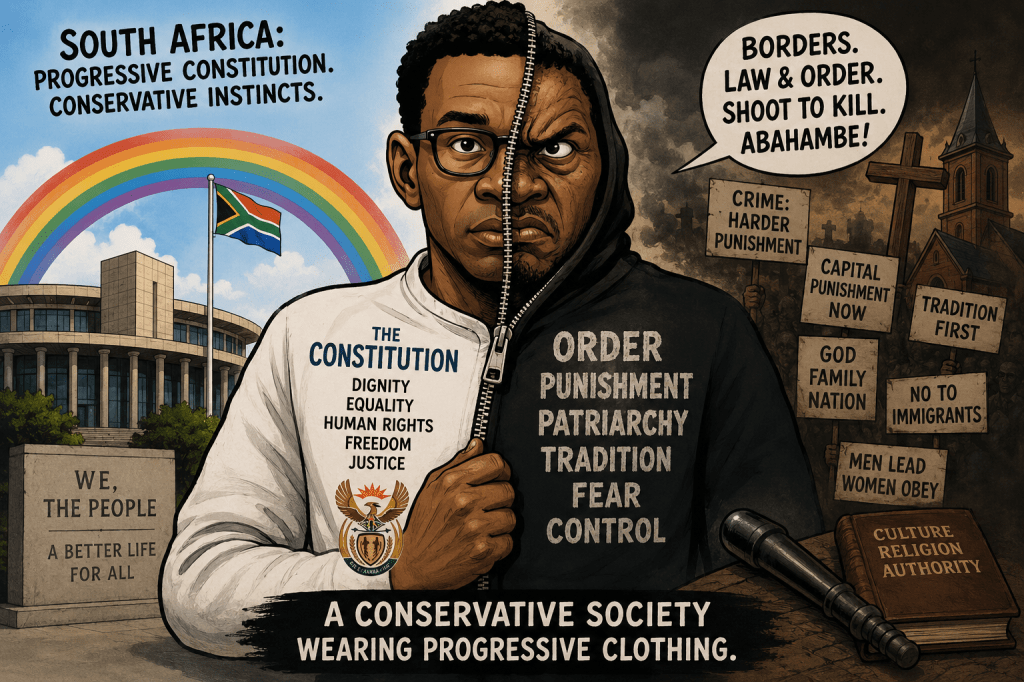
A Conservative Society Wearing Progressive Clothing
South Africa is not the progressive society it imagines itself to be. It is a conservative society with progressive branding. The Constitution is liberal. The society is not. The liberation movement was left. The masses were not. They were materially deprived, culturally conservative and morally traditionalist. They still are.
Look at the issues one by one:
- Crime and policing. The overwhelming majority support harsh policing, even extra‑judicial force.
- Capital punishment. Most South Africans want it back.
- LGBTQ rights. Deep discomfort and often open hostility.
- Sex work. Widespread moral rejection.
- Drug addiction. The instinct is force, not harm‑reduction.
- Immigration. Suspicion, fear and punitive impulses dominate.
- Gender roles. Patriarchy remains the default setting.
- Religion. Christianity is cultural law.
These are not fringe views. These are mainstream black South African views. As Author and Columnist Ndumiso Ngcobo says, if you were to superimpose these instincts onto the American electoral map, they would align almost perfectly with traditional red states.
The IFP: Traditionalism as Political Identity
The conservative undercurrent becomes even clearer when examining the political formations that dominate the landscape.
The Inkatha Freedom Party has always been a conservative organisation. Its foundations lie in traditionalist Zulu nationalism, patriarchal authority and a worldview that privileges order, hierarchy and cultural continuity. Inkatha’s political DNA was shaped by a belief in social discipline, respect for traditional leadership and a suspicion of radical economic experimentation.
Even during the liberation struggle, when the ANC and UDF were animated by leftist rhetoric, Inkatha positioned itself as the custodian of cultural conservatism and social stability. That legacy has not disappeared. It remains embedded in the party’s ethos and in the instincts of its supporters.
ActionSA: Market Fundamentalism and Law‑and‑Order Politics
The same conservative thread runs through ActionSA, though expressed in a different register. Herman Mashaba built his political brand on naked capitalist rhetoric, personal responsibility and a near‑religious faith in the market. His politics are unapologetically pro‑business, anti‑regulation and deeply sceptical of the state’s role in social transformation.
Mashaba’s positions on immigration are not administrative concerns. They are ideological commitments rooted in a worldview that sees social order as something threatened by outsiders and preserved through uncompromising enforcement.
His language mirrors global right‑wing populism, even as he insists he is simply being pragmatic. But pragmatism is often the mask that conservatism wears when it wants to appear modern.
The Patriotic Alliance: Populist Conservatism in Full Colour
Then there is the Patriotic Alliance, the most overtly populist formation in the country. The PA thrives on right‑wing rhetoric, and its leader, Gayton McKenzie, has perfected the art of political provocation. His flirtation with Zionism, his enthusiastic embrace of the Abahambe ideology on immigration and his tough‑on‑crime posturing are not random outbursts. They are deliberate appeals to a constituency tired of disorder and eager for swift, decisive action.
The PA’s rise is not an anomaly. It is a symptom of a society whose instincts lean toward punitive solutions and strongman politics.
The Left Is Not Exempt
Even the ANC, which still wraps itself in the language of social democracy, is sustained by a base whose views on gender, sexuality, policing and social order are far more conservative than the party’s official documents would ever admit.
And the EFF, despite its radical economic rhetoric, is anchored in a patriarchal, militaristic and deeply moralistic worldview that mirrors the very conservatism it claims to oppose.
This is the point South Africans refuse to confront. The conservative instincts that shape our politics are not imported. They are homegrown. They are rooted in our history, our religious traditions, our communal structures and our anxieties about disorder.
A Conservative Nation Inside a Progressive Constitution
South Africa is a conservative society trapped inside a progressive constitutional dream. The Constitution imagines a country that does not exist. It imagines a society that is tolerant, inclusive, rights‑based and committed to human dignity.
But the society that actually exists is anxious, punitive, patriarchal and deeply religious. It fears disorder more than it values freedom. It seeks control more than it seeks justice.
Until we confront that truth, we will continue to misread our own society. We will continue to misunderstand our own politics. And we will continue to be shocked by things that should not shock us at all.


Leave a Reply