By Nco Dube | 19 March 2026
The Catholic Church has survived for two millennia not because it has been fashionable, but because it has been stubborn. Its endurance rests on an unbroken chain of doctrine, ritual, and authority that has resisted the tides of empire, modernity, and cultural upheaval. That stubbornness is often celebrated as fidelity. Increasingly, however, it is beginning to look like paralysis.
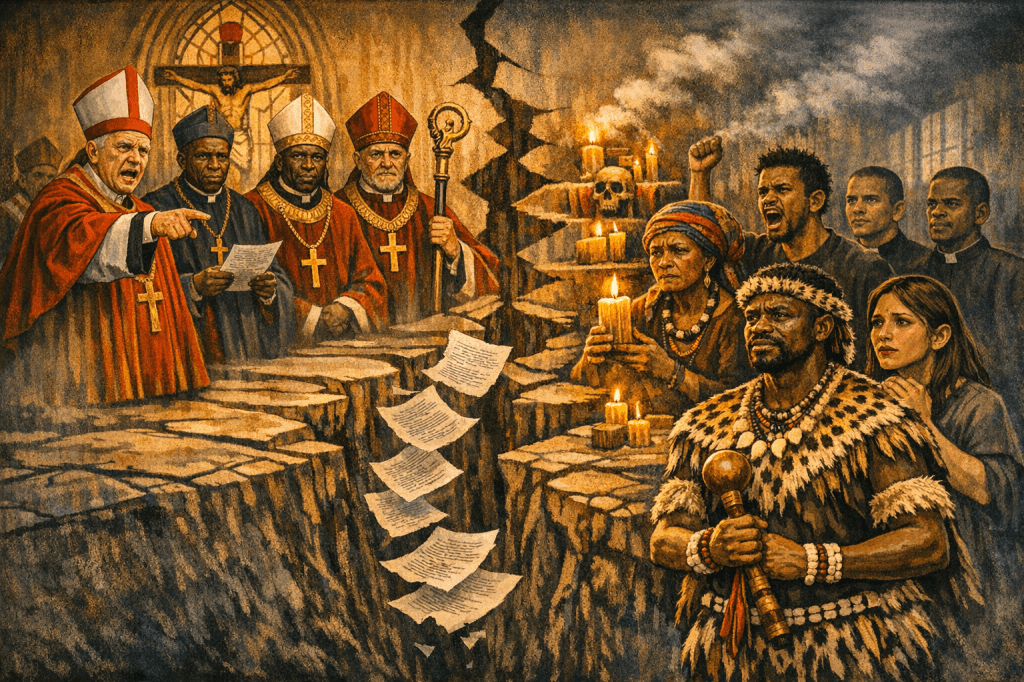
The recent controversy in the Archdiocese of Durban has exposed more than a disagreement over syncretism. It has revealed a Church that struggles to speak clearly to its own people, and to listen without retreating into reflexive defensiveness. The problem is not that the Church holds fast to ancient traditions. The problem is that it often refuses to translate them into a language that clergy and laity can inhabit without feeling either infantilised or ambushed.
In September 2025, a pastoral letter on syncretism was issued and signed by Archbishop Siegfried Jwara, retired Cardinal Wilfrid Napier, and six other bishops of KwaZulu‑Natal. The letter condemned the participation of some Catholic faithful in ancestral rituals and the consultation of traditional healers. Its language was broad and disciplinary, and it made little effort to distinguish between private cultural practice and public ecclesial ministry. For many readers, it read as a sweeping rejection of ancestral veneration itself.
The reaction was swift and emotional. Parishioners felt accused. Clergy felt exposed. Practices that had long existed in a grey zone were suddenly framed as incompatible with faith. The letter did not acknowledge the Church’s own history of silence on these matters, nor did it prepare the faithful for a shift from tacit tolerance to explicit correction.
Then, in October, Archbishop Jwara issued a clarification.
In that letter, the Archbishop stated plainly that the Church was not opposed to ancestral veneration. Africans, he explained, do not worship ancestors but honour and seek guidance from departed family members who lived virtuous lives. He emphasised that the bishops’ concern was not cultural identity, but the integrity of priestly ministry. The pastoral letter, he said, was directed specifically at priests who mix traditional healing practices, particularly ubungoma, with Catholic liturgy and parish life.
The clarification was theologically sound. It was also institutionally destabilising.
By narrowing the scope of the original letter after the fact, the Church inadvertently confirmed what many had already suspected: that its internal messaging was inconsistent and its external communication poorly considered. What had been presented as a unified episcopal stance now appeared fractured. The faithful were left to reconcile two messages that should never have been separated in the first place.
This contradiction did more than confuse. It explains the reaction.
For decades, the Church has tolerated a quiet duality in the lives of many African Catholics. Families attended Mass, baptised their children, and buried their dead according to Catholic rites, while privately consulting traditional healers or performing ancestral rituals. The Church largely avoided confronting this reality directly. Silence became accommodation.
Accommodation became expectation.
When priests appeared to embody that duality publicly, it felt to many like long‑overdue recognition. It suggested that what had been practised quietly at home might finally be acknowledged as legitimate within the Church itself. When the Church then intervened without careful explanation, the response was not simply theological disagreement. It was emotional shock. What felt like acceptance was suddenly withdrawn.
This is not a defence of syncretism in priestly ministry. It is an explanation of why the faithful reacted as they did.
The deeper issue is cultural power.
The Catholic Church often speaks of itself as the People of God, yet in practice it behaves as though the Church is synonymous with its leadership. Culture is defined from the top down. The Pope, Cardinals and Bishops deliberate, pronounce, and correct. Clergy and laity are expected to receive, comply, and carry on. Their labour, loyalty, and sacrifice are assumed. Their voice, insight, and lived experience are rarely invited into the shaping of the Church’s direction or character.
The faithful are expected to work tirelessly and selflessly for the Church while having little meaningful say in its main affairs. Obedience is demanded. Participation is limited. When decisions are made without consultation and communicated without care, they feel imposed rather than pastoral.
Nowhere is this imbalance more visible than in the experience of women. Women form the backbone of parish life. They catechise children, organise communities, sustain prayer groups, and keep churches functioning at the most basic level. Yet they remain excluded from decision‑making, sacramental leadership, and theological authority. They are told they are essential, while being structurally sidelined. This contradiction is not incidental. It is cultural.
The syncretism controversy has exposed this fault line. The laity’s reaction is not only about ancestral practices. It is about a Church that expects loyalty without dialogue, sacrifice without voice, and obedience without explanation. When authority speaks without listening, correction feels like punishment rather than care.
This is not a doctrinal crisis. Catholic teaching on priesthood remains clear. A priest is configured to Christ and acts in the person of Christ. His public ministry is not his own. He cannot embody competing spiritual authorities without undermining the coherence of the sacraments. That position does not require revision.
What does require revision is how the Church exercises authority.
The irony is that the Church has adapted before, and survived because of it. It moved from Latin to vernacular liturgy. It revised its stance on religious freedom. It re‑examined its relationship with science. Each adaptation was resisted. Each was eventually recognised as necessary.
What is required now is not doctrinal surrender, but institutional humility. The Church must learn to speak with one voice, and to explain itself before it disciplines. It must recognise that ambiguity tolerated for decades cannot be resolved overnight without consequence. And it must accept that authority today is sustained not by silence, but by credibility.
If the Church continues to rely on tradition without translation, authority without explanation, and correction without conversation, it will not be destroyed by external hostility. It will simply lose the confidence of those it seeks to shepherd.
Institutions do not perish because they adapt.
They perish because they refuse to understand why their people react when they are finally told no.
(Dube is a noted Political Economist, Businessperson, and Social Commentator whose insights are regularly featured on Ukhozi FM and in various newspapers. For further reading and perspectives, visit: http://www.ncodube.blog)
 The Social Commentator
Leave a comment